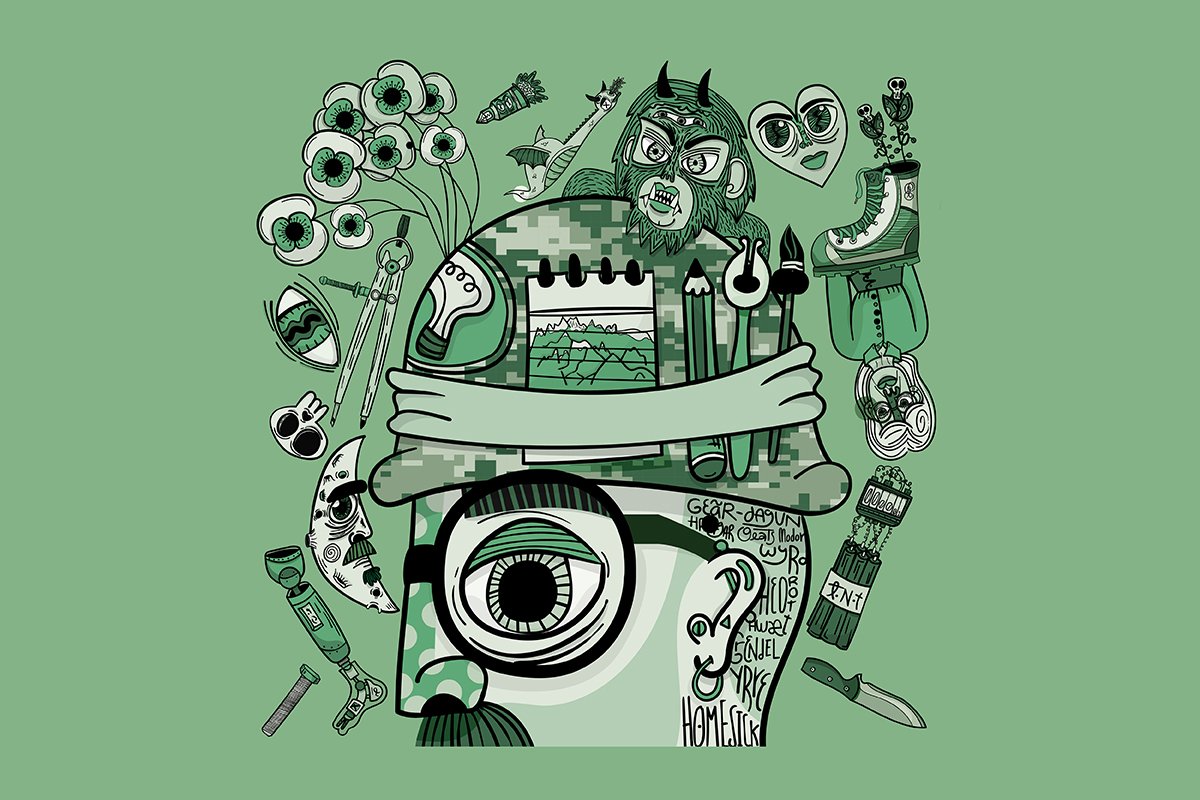
Media about war stories have been done before – some may say they’ve been overdone. So then, what makes Beowulf in Afghanistan different? For starters, instead of just showing the audience how the war happens, it shows the audience why the war happens, or, to a greater extent, why any war happens.
Beowulf in Afghanistan tells the story of Grant Clearly, a Canadian soldier who is injured in an IED explosion in Afghanistan. As he struggles through the desert, bleeding and alone, he begins to experience visions of his English professor, Professor Flynn. She gives lectures to Grant regarding Beowulf and the epic triumphs and defeats he undergoes. Grant likens Beowulf’s experiences to his own, serving in a war some 3000 years later. He debates whether or not Beowulf was truly a hero, and asks himself if he is a hero. What does it mean to be a hero? What does victory actually entail?
The set was beautifully designed – a raked beige stage depicts the sandy dunes of Afghanistan perfectly. In act one, the stage is bare, save for a small crop of flowers – five or six – miraculously growing despite the war-torn country around them. In act two, the same raked stage is used, but now it’s been transformed into an office, complete with a desk, a chair, and bookshelf, as well as two people’s moving boxes – one clearly moving out, and one moving in to replace the other. Keeping and adding to the dessert set during act 2, when they are supposed to be in an audience, allowed for doubt to begin to emerge in the audience: did Grant ever get rescued, or is he still alone and dying, hallucinating in the desert?
Despite the brilliant playwriting and directing, this show was not without fault. Although the acting was well-done for the most part, it seemed at times that the actors did not quite know their lines well enough, and it gave the impression that they were searching for the next thing to say. This takes the immersion away in a show that was otherwise wholly immersive, and takes away from the overall experience.
The most chilling motif depicted in this production is the mugs. In act one, Grant struggles – injured, overheating, lost, stranded, and most importantly, dying of thirst. Professor Flynn graciously offers Grant a mug of tea. However, devastatingly, when Grant goes to take a sip, he finds the mug to be full of sand, the same sand he’s stranded amongst. In act two, the same story – Grant has a cup of tea with the Professor. Horrifyingly, the mug is once again full of sand, leaving the audience to continue to again ponder whether Grant ever escaped Afghanistan.

 Lucy Baker
Leave a comment